Mattress guides · Sleep setup
Adjustable Beds and Natural Latex: Flexibility, Support, and Setup
An adjustable base changes the bed beneath you, raising the head, lifting the legs, or shaping both ends into a new position. A mattress must move with it. Natural latex can be a promising partner because it is resilient and responsive, but compatibility depends on the mattress’s full construction—not simply the word “latex” on its label.
Published November 3, 2026
A bed that moves is a different kind of foundation
A traditional bed holds the mattress in a relatively flat position. An adjustable base introduces motion: a hinged platform raises the upper body, elevates the legs, or articulates in more than one section. The change can make reading or resting in bed more comfortable, and some people value the ability to vary their sleeping position. But it also asks the mattress to bend, settle, and return to a flat posture repeatedly.
That movement makes the relationship between base and mattress important. The base provides the motion; the mattress must accommodate it while continuing to support the body. A mattress that is too rigid, too thick for the mechanism, or incompatible with the base may resist articulation, shift out of alignment, or feel different when raised. The right pairing is therefore a matter of design and fit, not a guarantee attached to any single material.
Natural latex is often considered for adjustable beds because it tends to be elastic: under pressure, it compresses and then recovers. Yet a mattress is more than its core. Quilting, upholstery, covers, internal layers, edge construction, and overall thickness all affect how the complete sleep surface responds when bent. A thoughtful setup begins with the manufacturer’s compatibility guidance and the adjustable base’s own requirements.
What “natural latex” tells you—and what it doesn’t
Latex is valued for its buoyant, responsive feel. Rather than slowly conforming in the same way some other foams do, latex generally compresses under load and pushes back, which can make repositioning feel comparatively easy. That spring-like response is one reason a latex mattress may be considered for an articulating base.
But the material name alone cannot establish adjustable-base compatibility. Latex mattresses differ in their construction, and a model may combine latex with other foams, fibers, or upholstery. The outer layers may bend differently from the core. A thick quilted top, densely built border, or stiff cover could influence articulation even where the latex itself is flexible. The practical question is whether the manufacturer approves the entire mattress for the particular type of adjustable base.
“Natural” also describes material sourcing, not a complete performance specification. It does not tell you how firm a mattress will feel, how much it will flex, or whether it is designed to articulate. Look for construction details and clear compatibility information rather than relying on broad labels. When important details are missing, ask the manufacturer or retailer before buying.
Natural latex may be one component in a comfort system that includes wool and cotton. These layers can affect cushioning and surface feel, while the latex core contributes much of the mattress’s support and resilience. The layers work together. A mattress should be evaluated as a whole, especially when it will be used in a moving configuration.
How articulation changes the feel of support
When a base raises the head or legs, the body’s contact with the mattress changes. Some parts of the body may press more firmly into the surface; others may be supported at a different angle. That can alter the sensation of firmness and pressure even if the mattress itself has not changed. A position that feels comfortable while lying flat may feel unlike itself with the head elevated.
Support is not a single quality that can be judged by firmness alone. It involves how the mattress responds to a person’s shape and position, and whether the surface feels stable and comfortable over time. A responsive latex construction may adapt as the bed moves, but personal experience depends on body weight, sleep position, the mattress’s firmness, and how far the base is raised.
Use small adjustments at first. Raise one section gradually, pause, and notice whether the mattress remains settled and whether the position feels comfortable. There is no need to assume that a higher angle is better. The goal is a usable sleep setup that feels supportive to the individual, not to achieve a particular shape or copy someone else’s preferred position.
An adjustable bed is not a substitute for medical advice. People managing pain, breathing concerns, circulation issues, or other health conditions should discuss sleep positioning with a qualified health professional. A mattress and base can affect comfort, but they do not diagnose or treat an underlying condition.
Compatibility is a system check
Before pairing a natural latex mattress with an adjustable base, confirm that both products are intended to work together. Compatibility statements are more useful than assumptions about material flexibility. Check the mattress documentation, the base manual, and warranty terms. If either manufacturer specifies limits on mattress thickness, weight, platform design, or motion, follow those requirements.
- Check the exact mattress model. Do not assume that approval for one latex mattress applies to another, even if both have similar names or materials.
- Review the base’s limits. Confirm the supported mattress dimensions, thickness range, weight capacity, and any restrictions on mattress construction.
- Ask about warranty conditions. Improper support or use outside stated guidelines may affect coverage. Keep product documentation and written guidance.
- Confirm the bed frame and clearance. Make sure the adjustable base fits within the frame and that moving parts have room to travel without hitting furniture or a wall.
- Consider the whole bed’s weight. The mattress, bedding, and sleepers all contribute to the load the base must handle.
These checks matter whether the mattress is an all-latex design or a hybrid. A hybrid may include coils or other components that affect bending. A mattress advertised as compatible should still be used within the specific conditions described by its maker.
Thickness, quilting, and construction
Mattress thickness is a practical consideration because a thick, heavily layered sleep surface may not articulate in the same way as a thinner, simpler one. That does not mean that thin mattresses are automatically suitable or that thicker ones are automatically unsuitable. It means that the base and mattress need to be matched according to their stated specifications.
Construction can matter just as much as depth. A latex core may be flexible, while a substantial comfort package above it may make the finished mattress less willing to bend. Conversely, a well-designed layered mattress can be intended to move as a unit. Ask whether the complete mattress—not only its core—has been tested or approved for use on an adjustable base.
Pay attention to the surface and border as well. Quilting can add cushioning and change how the top layer responds. A robust border may help the mattress retain its shape in ordinary use, but buyers should not infer from that feature whether the mattress will articulate. Manufacturers can provide the relevant guidance for that model.
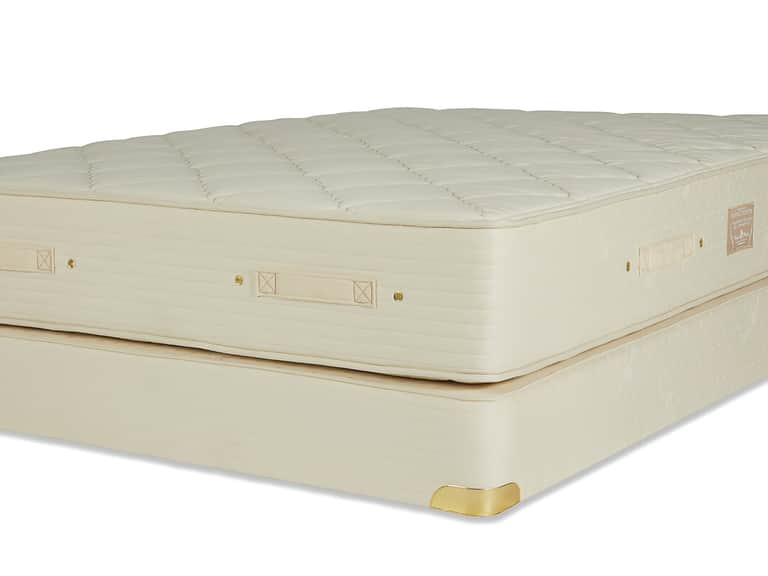
One example specifically described as suitable for an adjustable bed base is the Royal-Pedic Premier Natural Latex Quilt-top Mattress. Its listed construction includes a 10-inch natural latex core, with medium latex in the center and softer layers on both sides, surrounded by wool and a cotton outer fabric. The manufacturer also describes it as flippable and states that it may be used on an adjustable bed base. Buyers should still confirm that the chosen adjustable base meets the mattress’s requirements and review current warranty and setup guidance.
A careful setup, step by step
Installation is not merely a matter of placing a mattress on a platform. The base must be assembled and operated according to its manual, and the mattress must be positioned so it can move with the mechanism. A few deliberate checks can prevent avoidable shifting, pinching, or interference.
- Read both manuals before assembly. Identify required clearances, mattress limits, electrical instructions, and any safety warnings. If details conflict, ask the manufacturers to clarify before proceeding.
- Place the base on a stable surface. Confirm that its legs or frame sit evenly and that the mechanism has unobstructed room to move.
- Center the mattress while the base is flat. Align the head, foot, and sides with the platform. Use the base’s mattress-retention feature if one is provided and permitted.
- Test movement without excessive bedding. Raise and lower the sections gradually. Watch the mattress edges and corners for sliding, buckling, or contact with the frame.
- Add bedding and check again. Deep-pocket sheets or fitted protectors must allow enough movement and must not pull the mattress out of alignment. Avoid straps or accessories that the manufacturers do not approve.
- Repeat the alignment check. After the first night and after moving the base, make sure the mattress remains centered and that cords or nearby objects have not entered the moving area.
Do not force a mattress to bend into a position the base cannot achieve smoothly. If the mattress bunches, slips, or appears to strain, return the platform to flat and consult the relevant manuals or support teams. Persistent movement is a reason to reassess fit and installation—not to add improvised restraints.
Sheets, protectors, and everyday details
The mattress is only one part of the adjustable sleep surface. Fitted sheets, mattress protectors, and toppers can alter how the bed moves. A tightly fitted layer may pull at the corners as the platform bends. A loose layer may shift or gather. Choose bedding with a fit and construction that accommodates the mattress depth and the range of movement permitted by the base.
Before adding a topper, check whether it is suitable for articulation. A topper that moves independently can crease or drift, while one that is firmly secured may still affect the way the surface bends. Avoid assuming that a topper will improve support or correct a compatibility issue. The mattress and base need to work together without relying on accessories to overcome a mismatch.
Protectors and pads should also fit the mattress securely without compressing it excessively or restricting movement. Follow care labels. Some materials require gentle washing, line drying, or professional cleaning; others may be machine washable. Care instructions are product-specific, and cleaning a natural-fiber layer improperly can change its feel or shape.
Keep the moving parts accessible. Bedding should not obstruct the base’s joints, cables, or safety features. Check that bedside tables and under-bed storage remain clear of the platform’s path, particularly when the base is raised or lowered.
Care and longevity
A flexible base changes the mattress’s position, but it does not remove the need for ordinary mattress care. Follow the manufacturer’s instructions for rotation or flipping. Some latex mattresses are designed to be turned; others are not. A mattress that is flippable should only be handled according to its own guidance, and the base should be flat before repositioning it.
Inspect the setup from time to time. Look for a mattress that has drifted off-center, bedding that catches on the frame, or a base that makes unfamiliar sounds. Check that the frame remains stable and that moving components are unobstructed. If the mattress begins to feel uneven, determine whether it has shifted or whether another part of the setup needs attention.
Use care when moving a latex mattress. Its weight and construction can make handling awkward, and bending or folding it beyond the manufacturer’s instructions may damage it. If repositioning requires lifting, use appropriate assistance rather than dragging the mattress across the base or pulling on its cover.
Questions to settle before choosing
A good purchase decision often comes down to a short list of specific questions. Ask the retailer or manufacturer whether the exact mattress can be used on the exact adjustable base under consideration. Clarify thickness limits, required support, approved accessories, and warranty conditions. Then consider the practical realities of the room: space for articulation, access to power, frame dimensions, and the needs of everyone who will use the bed.
Comfort should be assessed in the positions you expect to use. If possible, test the mattress both flat and raised, allowing time to notice how the surface feels beneath the shoulders, back, hips, and legs. A showroom impression is not a promise of how a mattress will feel at home, but it can help identify preferences. Where a trial period is offered, read its conditions carefully.
Also consider whether the base and mattress are purchased as a coordinated system. Buying them separately can work, but it places more responsibility on the buyer to confirm dimensions, flex requirements, and warranty alignment. Written confirmation is useful when compatibility is not clearly stated in the product materials.
The useful principle: verify, then adjust
Natural latex and adjustable beds can be a sensible combination when the mattress is designed for articulation and the base supports its size and construction. Latex’s responsive character may suit a moving platform, but material alone cannot settle the question. Thickness, quilting, layers, mattress retention, and the base’s own movement all shape the result.
The best setup is not defined by a dramatic angle or a technical label. It is one that moves smoothly, stays aligned, respects manufacturer guidance, and feels comfortable in everyday use. Start with compatibility, set up the bed carefully, and make adjustments gradually. In a bed designed to move, the details beneath the sheets matter as much as the position you choose.